
175 Years
of the Swiss franc
The Swiss franc has been Switzerland’s currency since 1850. Its legal basis is the Act on Federal Coinage. Before then, payments were made in cantonal currencies: guilders, francs, batzen, dubloons and denari.

The currency divide:
The decision was preceded by long discussions about the French decimal system or the southern German guilder system. Eastern Switzerland and Zurich argued in favour of adopting the southern German guilder. French-speaking Switzerland, Bern and Basel, conversely, wanted the French decimal system, and their arguments finally prevailed.
In hindsight, this was a wise decision. As it turned out, the guilder soon disappeared into obscurity. It was supplanted by the mark when the German Reich was founded in 1871, and efforts to establish a common currency also began in that country.
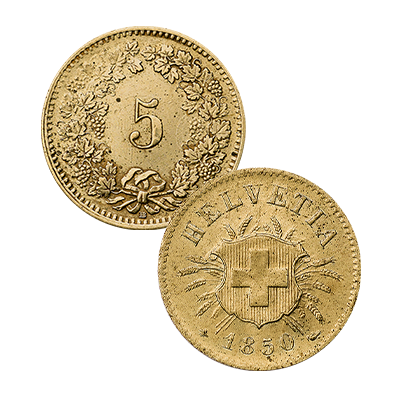
The first coins:
For capacity reasons, the coins from the first two years (1850 and 1851) were minted in Paris (mint mark A) and Strasbourg (mint marks AB and BB). The 1 and 2 centime pieces were made of bronze, the 5, 10 and 20 centime coins from an alloy known as billon, and the 1, 2 and 5 franc coins from 0.900 silver.
Banknotes:
The Act on Federal Coinage regulated coins but it did not cover banknote issuance, which was in private hands. Initially, the right of issuance was limited to joint-stock banks and cantonal banks, but then the federal government was granted the monopoly. In 1905, the National Bank Act was passed, and two years later the Swiss National Bank (SNB) opened its counters. In the period after its establishment, the SNB did not have time to design and print new banknotes, so the first banknote series consisted of interim notes. These reproduced the designs of the earlier issuing banks, but were overprinted with a red rosette containing a Swiss cross. The first banknotes were available in denominations of 50, 100, 500 and 1,000 francs. They were recalled in 1925 and declared not legal tender in 1945.
The Swiss National Bank holds the exclusive right to issue banknotes in Switzerland. It supplies the economy with high-quality, secure banknotes and, on behalf of the Confederation, also puts coins into circulation.
