
Withdrawal of 1-centime coins from circulation
2026 will see the 20th anniversary of the 1-centime coin being withdrawn from circulation. How did this decision come about, and why did 1-centime coins from 2006 become a popular collector’s item?
How did this decision come about?
In October 2005. the Federal Department of Finance (FDF) launched a hearing on the planned withdrawal from circulation of the 1 and 5-centime coins. The planned withdrawal of both coins was one of around 150 measures under the Federal Administration’s Systematic Programme for the Renunciation of Tasks for 2006 to 2008. The proposal to discontinue the two smallest denominations came from Swissmint. At that time, the 1-centime piece was already rarely used in everyday payment transactions. It was used only as a lucky charm or for publicity purposes. Yet, at 12 centimes per coin, production costs vastly exceeded face value, and the stocks of the alloy used by Swissmint would in any case only have lasted until mid-2007.
During its meeting of 12 April 2006, the Federal Council decided that the 1-centime piece would no longer be legal tender with effect from 1 January 2007. Conversely, the 5-centime piece was retained, despite the high minting costs of around 6 centimes per coin.
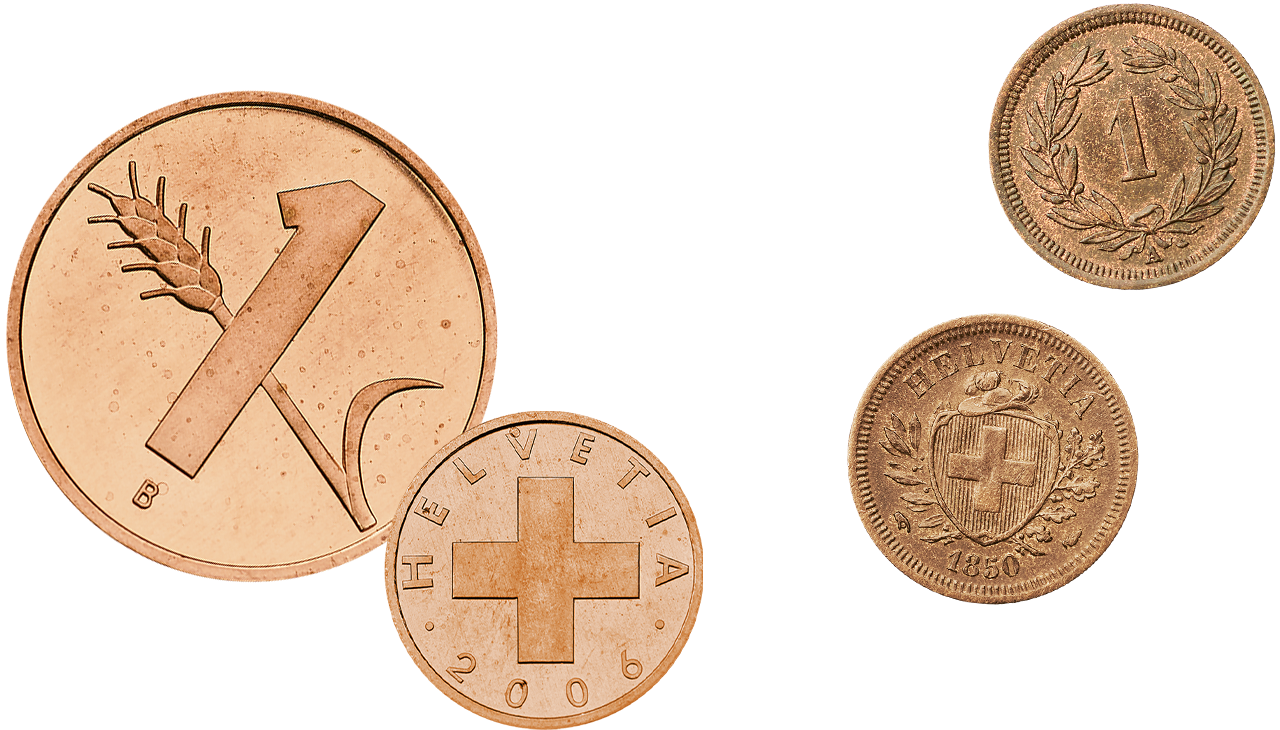
Why are 1-centime pieces from 2006 such desirable collector’s items?
At the time of the Federal Council’s decision, the Swiss National Bank still had enough reserves of 1-centime pieces from earlier years. It was therefore decided not to proceed with the planned minting of 1.5 million 1-centime coins under the 2006 regular minting programme. Thus, the number of 2006 1-centime pieces amounted to those minted for the 2006 coin sets (brilliant uncirculated and proof quality, birthday and anniversary coin sets) – only 30,000 coins. So it is hardly surprising that the 2006 coins are particularly sought-after.
About the 1-centime coin
The 1-centime coin (also called the Einräppler or Räppler) was part of Switzerland’s currency until 31 December 2006, and was worth 0.01 Swiss francs. The reverse of the 1-centime piece features a Swiss cross next to the inscription ‘HELVETIA’ and the minting year, while the obverse shows an ear of grain overlaid with the number 1. This has been the coin’s motif since 1948; before that, a Swiss coat of arms was depicted, together with a broad-brimmed feathered hat and a laurel and oak wreath surrounding the number 1. Owing to the coin’s reddish colour (bronze alloy), the 1-centime piece can easily be distinguished from other Swiss coins.
Since 1948, over 230 million 1-centime pieces have been minted. Apart from a few million, they are theoretically all still in circulation. The 1-centime piece has always been a collector’s item, even more so since its withdrawal from circulation in 2007; it is used for advertising, as a souvenir or often as a lucky charm.
A look at the discussion around small denominations in other countries.
According to the US Department of the Treasury, the 1-cent coin will no longer be issued after 2026.
Some euro area countries are already attempting to do without the smallest euro-cent coins. In Finland, for instance, cash payments are rounded to the nearest five cents by law. Similar regulations exist in the Netherlands, Slovakia, Ireland, Italy, Belgium and Estonia (source: tagesschau.de). At national level, however, the 1 and 2-cent pieces cannot be abolished completely. This decision can only be made at European level.
In Australia, 1 and 2-cent coins were already withdrawn in February 1992. They still remain legal tender.
A few years ago, the UK Exchequer launched a discussion on abolishing the 1-pence and 2-pence coins, but had to drop the idea following a huge public outcry.